Showing posts with label Teamwork. Show all posts

Saturday, April 4, 2015

A Year Abroad for Study & Synchro!

High school Junior Gates Bryan is one of approximately 1,100 American teenagers studying abroad this year with American Field Service(AFS-USA).  But Gates, a long-time member (since 5th grade!) of ANA Synchro, didn’t want to just study abroad, she wanted to swim synchro too!  So, with the help ANA Synchro Head Coach Leah Pinette, Gates found a host family in the south of France who was involved with synchronized swimming as well! 

Gates, third from right, poses with her new French
friends and teammates after a recent competition.
We checked in with Gates shortly after her French team’s first competition.  Read on to find out how she’s getting along with swimming synchro in France:

ANA Synchro:  What’s the name of your team?

Gates:  My team is Nautil Club Boucain.  Our colors are lime green and black, which is pretty nice. You look kind of intimidating when you wear it. <she smiles>  It’s a big team – just under 100 people.  I don't really know everybody on the team because I don't practice with everybody at the same time. 

ANA Synchro:  Does France have the same age groupings as we do in the US?  Are you a “16 – 19 Age Group” athlete over there?

Gates:  No. Here, they have Novice, they have “Espoirs,” which translates to “hope,” and they have Junior and Senior. I’m a Junior.  “Senior” functions as a masters team because Senior is for everyone above the age of 18. My coach, for example, is on the Senior team.  I would say Espoirs is in-between what we know as Intermediate and Age Group.  Here in France, you also have to pass tests to move up levels.  I had to pass the gold test to be able to swim as a Junior in France.  It really wasn't too hard, but I was still stressed about it because, if I didn’t pass, I wouldn't have been able to compete.

ANA Synchro:  Are you swimming a team routine?

Gates:  Yes I am.  We have seven people on my team.  I'm not swimming a small routine, which is fine by me.  It's already enough work swimming my team routine because it's extremely strenuous.  It's an extremely fast-paced, non-stop routine, so, by the time it's finished I'm good with just having to swim my team routine and not a small routine as well.

ANA Synchro:  How often does your team practice?

Gates:  Three times a week, which is less than my team back home. We practice two hours on Monday, three hours on Thursday, and three hours on Saturday.  So that's a lot less.  I can see the effect that has on my endurance, which kind of stinks because my team routine is so much harder here!  It's a very, very strenuous routine, and I am completely dead by the end of it.  So I'm missing that endurance that I wish I had.  Last year, and the year before that, and as far back as I can remember at least in high school, I really ate, slept, and lived synchro.  And so now on Sunday, when I don't have practice and I don't have homework, I say to myself “Whoa! What am I supposed to do with all this time? I have to find a hobby!”

ANA Synchro:  What kind of music do synchro athletes in France like to use for routines?

Gates:  Mostly about the same as back home.  They do have themes to most of their routines. The music to my team routine this year reminds me of aliens and extraterrestrials.  It's really, really weird, but it's kind of awesome at the same time!  They'll sometimes use classical music, and they'll sometimes use music with lyrics.  What I find funny is that, if they’re using music with English lyrics, I’m not sure they always know what the lyrics mean.  But it’s the same in the US.  We might use music that’s in Spanish or Russian, and we won't exactly know what the song is saying all the time either.  Sometimes, I'll hear some English lyrics that are either explicit or racy, and I can just imagine the faces of the judges back home if they heard it played for a routine!

ANA Synchro sends its warmest regards to Nautil Club Boucain
ANA Synchro:  Are the figures the same as the US?

Gates:  Yes, they're all the same.  My coach will say “Aurora” and my team will say, “which one is that again?”  But Aurora is something I've been doing for a while, so I know what she’s talking about.

ANA Synchro:  What has been the hardest thing about joining a French Synchro team?

Gates:  Definitely the language barrier. My coaches don’t speak English, so all the instruction is in French!  It can be really confusing and annoying at times when they say something, and I'll have to say “What was that word again?  I have no idea what you’re talking about.”  And you don’t want your coach thinking that you're not working hard because you don't understand something…like when everybody says “yeah, let's go” and they all go underwater, and I'm just left there on top of the water looking like an idiot because I didn’t know what was going on!  I can get frustrated and mad with myself if I end up getting yelled at because I didn’t understand something.  Luckily, in synchro, the pool deck is really loud most of the time anyway, so my coach can tell me with hand signals whether I was arched or that I piked, for example. 

ANA Synchro:  Are you fluent in French now?

Gates:  That's a tough question.  French fluency is not something that I can see myself ever achieving because there will always be something I can get better at.  There will always be more words to learn, more expressions, and more phrases.  I can conjugate better.  And so I would say I'm very proficient. I can get by just fine.  However, there are definitely moments when I don't know words.

ANA Synchro:  Do you automatically count to 8 really fast in French now or do you still count in English?

Gates:  I do both. They’re exactly the same for me now.  My teammates find it really funny when I count in English.  When I'm all alone, I'm in the habit of counting in English, but if I'm counting with my team, we all count in French.

ANA Synchro:  Have you had a meet yet?

Gates:  Yes, we just had our first meet this weekend!  <big smile!> It was extremely nerve-wracking for me!  My first meet in France!  Definitely a marked point in my life!  We got first in team, which was so awesome for me. I was so excited to blow the competition out of the water.  We had a score of 65, and the next team down had a 63.  I know a lot of people would look at that and say “that's nothing,” but, to me, that was a really big deal!  I came in 15th in figures, which wasn't my best figures day.  But I did all-right.  I'm going to look to advance next time.

Land drilling is done differently in the US and France.
ANA Synchro:  Any other similarities or differences that you'd like to share?

Gates:  Yes.  The way they land drill here is all in reverse compared to what we do in the US!  They land drill with their arms out in front of them, and it's really weird to me.  I really had to adjust the way I land drill.  Now, my teammates say I speak both land drilling languages!  Competitions are also much more relaxed, I think.  And it threw me off at first when the judges didn’t say “go” to start figures.  And my teammates find it so cute when I cheer in English because I don’t know how to cheer in French.  All they say is “Allez!” and I say “this is boring – I’m going to mix it up!  I’m going to cheer in English!”  They find that so funny!

ANA Synchro's 16-19 athletes with a message for Gates :-)
ANA Synchro:  Any final thoughts?


Gates:  I really love it here.  I have an awesome team.  I have a good coach.  She's nice and she's funny, but she definitely scares me – in a good way.  We’re really working hard.  I’m mentally preparing myself to die in practice this week because we have to get down to business before our next meet. We have a two-week vacation coming up, and in the second week, we will have seven practices in a row.  That's going to be so rough!  I'm just really looking forward to the rest of this season.  We’ll have French Nationals in May.  And then we have a big show the 20th of June which my parents are going to be able to see, so I’m really excited!  They'll be able to see me swim in France!  

Tuesday, February 3, 2015

Combined "Combo" Routine

In  Part 1 of this 2-part article on “Combo” routines, ANA Synchro Head Coach Leah Pinette described for us what a Combo routine is and the choreography challenges and opportunities it presents.  She also gave us a glimpse of ANA’s Combined Combo this season with Cambridge Synchro and the North Shore YMCA Selkies.  In this second and final part of the article, Coach Leah tells us more about how that joint venture came about and how she and the two other coaches manage it all.

Head Coaches:  (l-r) Katie Rice of Cambridge Synchro,
Carrie Reynolds of North Shore YMCA Selkies,
and Leah Pinette of ANA Synchro.
ANA Synchro:  Why did ANA Synchro, North Shore YMCA Selkies, and Cambridge Synchro combine this year for a Combo? 

Head Coach Leah Pinette:  Our three teams are combining for a Combo this year to give our older athletes a chance to work with others at their level and compete as one.  It’s really a unique opportunity in that these girls are swimming alongside girls they normally compete against.  That’s different because your competitors are who you watch – for years sometimes – and you look up to them.  Even though you’re competitors, you want to be able to swim with them too.  You want to be able to swim with the best in your group. 

ANA Synchro:  How do the rules allow for a combined Combo?

Head Coach Leah Pinette:  I learned about the opportunity to join forces at our national USA Synchro Convention last September.  USA Synchro put this into place to accommodate smaller clubs.  In the past, if you were a smaller club, you might have put together a trio of similarly-leveled athletes, but we don’t have trios any more as of this year.  So, USA Synchro is allowing teams to combine to give athletes an opportunity to get involved in a bigger group.  I thought it would be a neat opportunity for our older girls, so I reached out to a few teams in our area. 

ANA Synchro:  What was their reaction?

Head Coach Leah Pinette:  Both Carrie Reynolds, Head Coach of the North Shore YMCA Selkies and Katie Rice, Head Coach of Cambridge Synchro thought it was a great idea.  We coaches then reached out to our athletes to see if there was any interest.  Initially, we had about 20 who at least wanted to learn more about it.  In the end, we had 11 (10 swimmers + 1 alternate) who were willing to make the commitment.  According to the rules, we couldn’t call the combined Combo any of our existing team names, so we’re competing under the name “New England Synchro.”

New friends are being made in the New England Synchro
Combined Combo.
ANA Synchro:  How is it going?  Are the girls meshing together?

Head Coach Leah Pinette:  It’s going well!  It’s a huge learning experience for all of us, and I do find the girls are meshing.  They are not just hanging out with the girls on their own team.  All of the girls are open and welcoming, helping each other, and becoming a team.  Part of it, I think, is that all these girls really want to be here.  They had to consciously decide to commit to the extra practices, the driving to each other’s pools, and the time and expense of traveling to the bigger meets.  You don’t always get this full-on commitment with an ordinary age-group team, so having it with the Combo makes a real nice dynamic.

ANA Synchro:  How are the three coaches making it work?

Head Coach Leah Pinette:  We had never worked together like this before, so we definitely had to find our groove as coaches.  We each have different styles, which I think is turning out to be a positive to the whole experience.  Carrie is probably the most artistic one of the three of us, so she has great vision with solos and the presentation of everything.  Katie is a teacher, so she’s a very good communicator and very organized.  She tends to be the planner of the group.  And Katie is patient, which balances my coaching style because I tend to be the taskmaster of the group.  (That probably comes from all those years as captain of the National Team!)  I think we are all learning from each other, and, together, we’re creating stronger athletes all around, not with just our own.  We might even be getting a little spoiled having three head coaches around to be more eyes on deck and to independently watch all the different parts that make up a Combo.

Three Head Coaches on deck means three pairs of eyes
to watch over all parts of the Combined Combo

ANA Synchro:  So the girls don’t look to just their own coach for leadership?

Head Coach Leah Pinette:  Not at all.  They’re very comfortable taking direction and correction from all three of us coaches.  I actually love this part of it.  It’s the same reason I love when our athletes go to different camps and clinics.  Sometimes another coach can tell my athletes the exact same thing I tell them, and it’ll just click with them because they’ll hear it in a different way.  So, by providing these different perspectives on the same athletes, the athletes are improving, and we coaches are improving too, just watching how each other operates. 

ANA Synchro:  What has been your biggest challenge with the tri-team arrangement?

Head Coach Leah Pinette:  The biggest challenge is we don’t get together as a group as often as we would if it was just our own team.  So it’s January and the girls are still working on learning a couple of the laps.  Luckily, the season is young, and we have the flexibility to add more practice time if we need it as we get closer to the bigger competitions.  Another challenge is making sure the choreography is all connected, but that would be there regardless of whether we were doing a combined Combo or one with just our own team.

The Combo starts its Snow
White story on deck with a
dramatic portrayal of the mirror.
ANA Synchro:  How are the girls enjoying the storytelling nature of Combo choreography?

Head Coach Leah Pinette:  I think they like it because it’s different than anything they’ve done.  Our story starts on the deck!  Even though deckwork is not supposed to be judged, it is still a great opportunity to make a strong first impression.  We have one girl portraying the evil queen, another portraying Snow White, and the rest of them portraying the mirror.  The whole storytelling concept is pretty new for them, so I don’t think they got the mirror concept at first, but when they did, we just saw it all come together.

ANA Synchro:  Has there ever been a multiple team effort like this before for a Combo?

Head Coach Leah Pinette:  Actually, ANA Synchro has done a combined Combo years ago with the New Canaan YMCA Aquianas when Eugenia Gillan was Head Coach.  (Genia is now coaching Boston University's Synchro Team.)  Genia and Krista Karwosky (formly Bessinger) from New Canaan were talking about how they were both going to US Opens one summer, and decided to join forces for a Combo.  Because she had first-hand experience with a combined Combo, I asked Genia her opinion and for any pointers. 

ANA Synchro:  Have you gotten any feedback from other teams about your combined Combo?

Head Coach Leah Pinette:  Yes.  I was asking a lot of questions about it at Convention, and the other coaches there were giving positive feedback.  Carrie attended a choreography clinic in Colorado Springs earlier in the season where she asked a lot of questions about it as well.  She also got a lot of support, especially from the smaller teams who had representatives there.  I think if we can show a good example of it, that we were able to come together and make it work, maybe other teams will try it too.  I know we’re not necessarily the smallest team, but we can still show how it can work.  And who knows, I wouldn’t be surprised if other teams, especially the smaller ones, are doing the same thing already and we’ll see them at nationals.

The Combined Combo is a great learning experience
for both athletes and coaches.
ANA Synchro:  So you foresee doing it again?


Head Coach Leah Pinette:  Sure!  We’re showing that it can work.  If there’s enough interest, you can get the athletes competing at the skill level that they should be swimming.  The bottom line for me is this is good for synchro in general.  Our combined Combo is helping to develop our own athletes.  It’s helping us coaches learn from each other and stretch ourselves with new techniques for choreography.  And, though ANA Synchro has a long history of attending national meets, that’s not the case with all the teams in the US.  A combined Combo may be the thing that exposes more clubs and more athletes to higher level meets than what is available in their own region.  I know when ANA sent their first group to a national level meet years ago, they witnessed the top teams in the country and came back fired up to get to that level too.  And now, years later, we have routines placing in finals at those same national meets.  So, who knows what this could inspire!  But I’ll be excited to see what unfolds!


Tuesday, January 27, 2015

"Combo" Routines Explained!

This year, more clubs, including ANA Synchro, are putting together Combination (aka “Combo”) routines.  USA Synchro has added the event to Junior Olympics and all the way down to our association level meets.  In this first of a 2-part article, ANA Synchro Head Coach Leah Pinette helps us understand Combos:

A Combo routine can feature anywhere
from one to all ten of its athletes. 
ANA Synchro: What is a Combo routine?

Head Coach Leah Pinette: A Combination routine is made up of 8 to 10 swimmers, and USA Synchro is allowing athletes in the 13 & over Age Group to compete in them.  Unlike a typical team routine, where all athletes are doing pretty much the same thing, a Combo can separately feature anywhere from one to all ten of its athletes.  It’s longer, too, than a regular team routine by about a minute.  So, with a Combo, you have a chance to be more creative with the choreography and make it more of a “big story” routine. 

ANA Synchro:  What do you mean by “big story”? 

Head Coach Leah Pinette:  It means telling a story with the choreography.  Many Combos are based on musicals or movies so there’s a built-in storyline or theme.  For example, I swam a Combo routine based on Chicago which had so many different aspects to the storyline that we tried to convey in the water.  And I remember one of my favorite Combos was a West Side Story routine that I swam when I was on the US National Team.  We portrayed the Sharks and the Jets from our time on deck to swimming in the water.   I also love watching videos of some recent Combos that China has done.  You can look up their Phantom of the Opera and Alice in Wonderland routines on YouTube – they’re great!

ANA Synchro:  You said “today’s” Combos tell the stories….were they not always that way? 

Head Coach Leah Pinette:  They’ve definitely gotten much more involved than when they first started.  It used to be, for example, if you had a soloist performing, then everyone else was required to be on the side just eggbeatering.  And when it was time to swim again, the rest of the team would duck under the water, without being seen, to get into position.  They’ve relaxed those rules, so that’s why we have more free range today to play around with and build more intricate choreography. 

A "Combo" routine can have up to 10 athletes.
ANA Synchro:  Combos must be challenging to choreograph if you’re also trying to tell a story!

Head Coach Leah Pinette:  The challenge is getting it to flow and connect and still tell the story.  You want to please the eye.  If your solo or your duet is swimming, you want the rest of the team doing something, but not be distracting.  So, yes, it’s challenging to keep the focus where it should be.  It should be obvious to the audience where they should look.

ANA Synchro:  Why did USA Synchro add Combos to Junior Olympics this year? 

Head Coach Leah Pinette:  I think it’s related to the decision to eliminate trios from the age group track.  Those tended to have more fun with their choreography.   And trios aren’t competed on an international level whereas Combos are.   Combos are considered a spectator event, so they can actually help draw interest to the sport because they are so fun to watch.

ANA Synchro:  Are they judged the same as team routines? 

Head Coach Leah Pinette:  No.  The score is 100% routine, versus 50% routine + 50% figures for a team routine.  While figures are not counted, Combo athletes still have to compete in figures.  The routine score is still judged on Difficulty, Technical Merit, and Artistic Expression.  Technical Merit is how well you execute the moves and your synchronization; and Artistic Expression will include your use of music, overall presentation, and choreography.

13 & Over Age Group Athletes can compete this year in the Combo
event at Association-level meets as well as Junior Olympics.
ANA Synchro:  Do you expect to see a lot of clubs doing Combo this year? 

Head Coach Leah Pinette:  We’ll see as the season goes on who will be competing in a Combo.  When I was competing, most teams entered them at US Opens because they weren’t competed at any other competition throughout the year.  In the past, US Opens was held during the summer, when school was out.  Teams had more time to focus on this event especially since it wasn’t in our regular season meets.  I’m hoping teams that may not have them this year will consider having one next year.  This year, more athletes, coaches and spectators will be introduced to the event.  Honestly, I wouldn’t be surprised if we saw combination routines in the Olympics someday.

ANA Synchro: What’s the best way to approach a Combo if a club doesn’t have a lot of experience with them?

Head Coach Leah Pinette:   I’d recommend starting from a theme and going from there.  You could even look up old-style Combo routines where people were eggbeatering on the side while the solos and duets performed.  It’s still OK to do that, and it may give a club an easier starting point.  You don’t have to be so intricate with the choreography if you’re just starting out with Combos.  Luckily for ANA Synchro, we’ve done Combo routines before, and I have swum routines both in the old-style as well as the newer connecting-style.

ANA Synchro: What can an athlete learn from a Combo that she may not learn from a more traditional team routine?

Head Coach Leah Pinette:  I think the biggest thing they can learn is the bigger picture of a routine and how everything connects.  If they’re doing one thing in the water, they should be thinking about how they connect to others who may not be right next to them as they would be in a team routine.  These routines also are more artistically oriented than a technically-driven team routine which allows athletes to express more of their artistic side.  Synchronized swimming is, after all, a performance sport. 

Combo athletes are all smiles after their first meet of the season!
ANA Synchro: Finally, what is ANA Synchro doing for Combo this year?

Head Coach Leah Pinette:  Our theme is “Snow White and the Huntsman.”  We have someone portraying the evil queen, and someone portraying Snow White.  And we are delighted to be doing a Combo this year combined with athletes from two other clubs in our area – Cambridge Synchro  and the North Shore YMCA Selkies.  We’re just a few months into it, but so far it’s been a great experience for the athletes and for us coaches.  We can’t wait to take our Combo to more association level meets as the season progresses and national meets as well.


Stay tuned for Part 2 of “What is a Combo?” where we ask Leah to talk more about ANA Synchro’s combined combo with Cambridge Synchro and the North Shore YMCA Selkies!


Wednesday, May 21, 2014

Annual ANA Synchro Show – A Lot of Work, but a Lot of Reward!

Smiles are bigger and energy is higher when performing
for friends & family at the annual ANA Synchro show!
Last month, ANA Synchro hosted its annual show at the Andover/North Andover Y.  We are thrilled to announce that this year’s production, Defying Gravity, surpassed last year’s box office record and introduced synchronized swimming to many new fans in the community!

Putting on three performances like we do is a huge, annual, undertaking.  Is it worth it?  The coaches could have easily just worked with the athletes to prepare for the next competition.  The volunteers surely could have found other things to do with their time!  And the Y could have experienced just another calm weekend pool schedule. 

We asked a number of people involved in the show in different capacities their opinion on why we do a show.  Not be a spoiler, but the consensus was overwhelmingly positive in spite of the work!  Check out the different perspectives of the people we asked:

ANA Synchro athletes develop close bonds
by swimming all together at the annual show. 
Maxie Zimmerman, Athlete, Senior Team:  The show is a very fun event for the girls.  We all put a lot of work into the show, but it definitely pays off when show time comes around and we get to show off our routines and how great a sport synchro is!  I think we all love the show so much because it is the one time of year when we get to swim with not only our team of 8 people, but with all of our ANA sisters!  It brings all of us so much closer as a team!  

Audiences, and especially the athletes,
enjoyed seeing five coaches perform
an exhibition swim.  They still have it!
Leah Pinette, Head Coach (and someone who has been in her share of shows over the years!):  The show is a very fun event for the girls.  They’re performing just because they love the sport and want to share it with the community.  And it actually really helps us for competition because it closely simulates a competition environment – much more so than we’re able to achieve in an ordinary practice.  Even without the scoring pressure, the athletes will still get nervous because they want to do well in front of their friends and family.  The show gives them an important chance to learn how to control those nerves.  It definitely helps them bond so that when they do go to compete, they are a stronger team.  Not all that coincidentally, our Age Group athletes had an important qualifying meet the very next weekend after the show, and I’m happy to say all of them moved forward to the next round, on their way to Age Group Nationals later this summer.  The show was a nice warm-up for that.

Novice athletes get ready to show their stuff
in their first ANA Synchro show!
Ken and Marsha Cordio, first-year parents of a novice athlete:  We thought that the show was a great way to end the season for the novices, with an event that was very entertaining for all demographics.  Our daughter really enjoyed the opportunity to perform for her family and friends.  The show really educated our extended family about the sport, but in a thoroughly entertaining way.  We were so proud of and impressed with what the novice team could do!  

ANA Synchro teaches teamwork and other important life
skills - all in a fun, youth development-oriented environment!
Maureen M., Long-time Parent:  I saw my first show 9 years ago.  It really shows the heart of the Y people and how their programs shape and transform the lives of the people who are involved in them. Synchronized swimming has taught our daughters more than how to be great athletes. It has taught them so many life lessons about friendship, family, hard work, disappointment, conflict resolutions just to name a few.  It has been a vital part in making them into the strong, confident, healthy, happy, productive individuals that they are. I am so grateful for all the Y has done for our family.  I see the show as a way the swimmers and families can give back to the Y and show what a wonderful program we have and get others involved in the Y's programs.  

ANA Synchro athletes
develop confidence at the Y!
Alex Turek, Executive Director of the Andover/North Andover Y:  There are a few reasons the show is so important to the Y.  First, it is a great way to bring people into the branch that may never have been here before or know what we have to offer.  Second, we see the rich tradition associated with the show and with Marilyn Fitzgerald starting the team so long ago.  What a great way to honor our early beginnings in the sport!  But more than either of those, is the opportunity for the girls to showcase their talents in front of a crowd.  There is nothing like performing in public to boost one’s self-confidence and build character.  That’s what we are all about! 

Girls as young as 6 years old can join ANA Synchro!
Check our website for the next "Learn to Synch" class!
  Kate D’Ambrosio, Aquatics Director (and former synchronized swimmer herself!):  I think it’s so important for us to put on our annual Synchro show.  First, it’s a great way to get more information out there about what exactly synchronized swimming is and how difficult a sport it is!  Second, it’s a great way for the girls to showcase all their hard work for family and friends.  Third, it also shows young girls some of the different opportunities there are after swim lessons. So many kids track towards swim team because they don’t realize that there is another option.  The show highlights how much fun synchro can be, and it can really inspire younger kids.

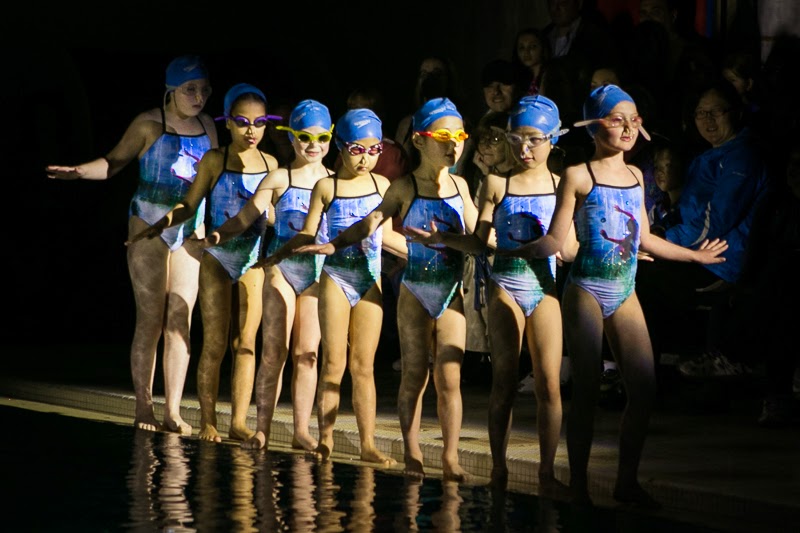
Synchronized swimming - a unique and beautiful sport.
Zsuzsa Belhazy-Kovacs, Veteran Coach of ANA Synchro:  Our show is a cohesive piece of work that brings everyone – parents, athletes and coaches – together, with significant help from the Y, to run our biggest community event and fundraiser of the year.  It allows everyone to participate and shine, regardless of their skill level, and be a part of a larger, integrated whole.  The athletes display not only excellence in the water, but sportsmanship, kindness, cohesive action, and lots and lots of fun.  All of this shines through every single performance, creates a very positive vibe, and attracts new athletes and their parents to our unique and beautiful sport.

A final dramatic solo swim for
 this graduating senior!
Gloria McNamara, Captain and Graduating Senior:   As a swimmer, the show means a lot to me. It's an opportunity for our friends and family to support the team and experience synchro as a performing art!   I don't think the audience realizes how much work goes on behind the scenes, but it's an amazing experience working with the entire team at once. I especially love seeing all the younger girls swimming next to the older girls. It does get stressful at times, but I think that the team, as a whole, really bonds through the experience.


The ANA Synchro show is an awesome team
and community event!  Join us next year
for the 38th annual show!


Readers….how about you? What benefits do you see for the athletes? Have you ever been part of a major production like the ANA Synchro Show? What benefits do you see for the athletes? For the volunteers? Let’s hear your stories in the comments section!

Saturday, February 22, 2014

ANA Synchro Welcomes Back Alumni for Coaching and Inspiration

ANA Synchro is fortunate to count many alumni among its ranks of fans and supporters.  Some, like 2011 graduate Alice Rodgers, come back to lend a hand coaching when they’re not in school.  “We very much appreciate when the college students come back to coach,” says Head Coach Leah Pinette.  “Not only are they really good at explaining moves because they’ve all swum synchro so recently, the girls on the team adore them and look up to them.”

ANA Synchro alum Alice Rodgers (center),
surrounded by current athletes at a recent practice.
We caught up with Alice on a recent break from the University of Tampa, where she is a sophomore.  This is the first of a two-part interview with her.

ANA Synchro:  What do you like about coaching that keeps bringing you back to ANA?

Alice Rodgers:   I coached 13 & Over Intermediates the very first year I coached, and I was hooked!   At the time, I didn’t perceive myself as one of the big girls yet because I was only a freshman in high school, but all of a sudden I was a coach and, suddenly, what I said mattered more.  It was like having all these sisters, who wanted to hear what I had to say, and I had to tell them what to do.  It was fun! 

ANA Synchro:  What do you find challenging about coaching?

Alice:   As a coach, you have so much information in your head, and you want to give the girls everything you know.  But it's difficult because you can't just give everything in one shot because the girls won't remember it.  So, one of the important things is to note what information is most critical based on the age and experience level that you’re teaching.  When little kids do their figures*, for instance, I really just want them to go out and smile at the judges, stay right in front of them, and then try to do the figure to the best of their understanding.  As they get older, I can give them more complex information to process.

*a “figure” in synchronized swimming is a basic element; they vary by age grouping; and girls perform a set of them, individually, in front of judges at every meet. 

Alice, on deck, calling on her synchro expertise, to give
tips to the 16-19 team as they run through their routine.
ANA Synchro:  Surely it must help your coaching that you swam synchro for all the years that you did?

Alice:   I think that, for someone who hasn’t swum synchro, the hardest corrections to make are the ones that involve the position of your body.  It's not about counts; it’s not about where you are in the pattern; rather, it's the lining up your body with itself that is the hardest thing to understand and communicate.  So it's really valuable to have done those positions because you understand why it's so hard.  Plus, you can explain it.

ANA Synchro:  Do you find yourself channeling one of the coaches you had when you were the athlete?

Alice:   I had a coach, Genia*, who, if she would find us off by ourselves at meets, would say "why aren't you with your teammates?  You should be with your teammates at all times!”  She believed in this – that there was a social aspect in addition to all the training.  Because when you walk out on deck to start your routine, being in the same mindset of your teammates is really important.  If you’ve all been seeing the same things and exchanging the same information for hours beforehand, you’re that much more likely to be able to go into the pool and perform as one, which is our goal.  At the last meet I went to with the girls as a coach, I found myself telling the girls the same thing.  I even wanted them to be listening to their music together as much as possible.  I wanted them to be very, very focused for when it was time to compete.

*former ANA Synchro head coach, Eugenia Gillan, currently Head Coach of Boston University Synchro.

ANA Synchro:  What did you learn from being on ANA Synchro?

Alice:   It's kind of a cliché to say for a team sport that it was team and leadership, but those are by far the most outstanding things.   I learned how to work with people from all different ages who don't necessarily think the same way as me.  We all had common goals, which were to succeed in routines, or figures, or whatever we were doing at the time.  So I learned how to work extremely hard toward a common goal with people who didn't necessarily try to get there the same way as me.

In terms of leadership, I was the captain of the team of 85 to 90 girls for two years in a row.  That's a lot of work!  I knew everyone's name.   Plus, I learned how to do things I didn't necessarily expect to know how to do as a captain.  Talking to parents, for instance.  I knew we would have to talk to parents, but I didn't expect to have to feel like a teacher talking to the parents about how their child was doing.

Also, speaking in public was an unintended consequence of swimming synchro.  I am much more comfortable now talking to a group of people I don’t necessarily know well.

ANA Synchro:  Will we see you back here on your next college break?

Alice:   I really hope so, because I want to keep involved and coaching for a long time.  I don’t want to forget anything I know, so I don’t ever want there to be a period of time when I stop doing it! 


Readers, stay tuned for Part 2 of our interview with Alice Rodgers.  Next month, we’ll find out her thoughts on synchronized swimming as a sport of choice, and we’ll learn how she found “sisters” at ANA Synchro!


For more information on the coaching staff at ANA Synchro, click here: http://anasynchro.org/coaches/index.php

ANA Synchro is the competitive synchronized swimming team of the Merrimack Valley YMCA’s Andover/North Andover Branch.  To visit the ANA YMCA's website, click here:  http://andover.mvymca.org/ANASynchro